
Cold cutting is a rebar processing method that does not alter the material’s properties because there is no direct contact with heat. Consequently, products cut using this method maintain higher quality. Cold cutting is superior for rebar as it preserves the material’s inherent characteristics and significantly enhances the final product’s integrity. When utilizing cold methods, one must consider the rebar’s weight and select the optimal cutting technique based on its weight, size, and dimensions. In this process, the material is cut to the desired length without direct thermal contact. Machinery such as water jets, band saws, circular saws, hand saws, and power hacksaws operate using the cold cutting method.
Advantages of Cold Rebar Cutting:
-
Preservation of the steel’s molecular structure.
-
Ability to cut rebar into various sizes and shapes.
-
High surface quality of the cut rebar.
-
Production of identical components.
-
No production of toxic gases.
-
Operational flexibility.
Disadvantages of Cold Rebar Cutting:
-
High initial cost of cutting tools.
-
High maintenance costs for the equipment.
-
Requirement for specialized labor.
Cold Cutting Equipment and Machinery
Band Saw Machine The invention of this machine sparked a revolution in the cutting industry due to its ability to cut thick sections with high precision. Key advantages include programmability, fully automatic operation, angled cutting capabilities, and minimal material waste. The band saw utilizes an electric motor to rotate its axes and a hydraulic cylinder to move the workpiece during the cut.
Circular Saw Machine This machine is a high-safety, high-quality alternative to the hazardous friction saw (“Ateshi” saw). It features various blades capable of cutting through metals with ease.
Power Hacksaw (Lāng Saw) Compared to the previous two machines, this device offers lower precision and generates more waste. Its cutting motion involves moving back and up across the workpiece. Due to its specific functional style, it is used less frequently than other machines.
Hand Saw The simplest and oldest tool for cutting rebar. While saws come in standard sizes, their tooth density varies. Thin rebars are cut with fine-toothed saws, while larger sizes require coarse-toothed saws. Human manual force is essential here to divide sections. It is important to note that this tool carries significant risks; safety equipment is mandatory as blades are prone to warping or snapping.
Water Jet Cutting Machine Water jets perform cutting operations on hard materials using high-pressure water pumps. Although currently used primarily for stone and less so for rebar and metals, they perform exceptionally well on hard substances. Their high precision, speed, and automated nature have quickly gained them many proponents.
BS35 Hydraulic Rebar Shears When high speed is required to cut a large volume of rebar in minimal time, this machine is the ideal choice. It features wheels for easy portability. Rebars up to 35 mm in diameter can be cut using this device via both manual and electric methods.
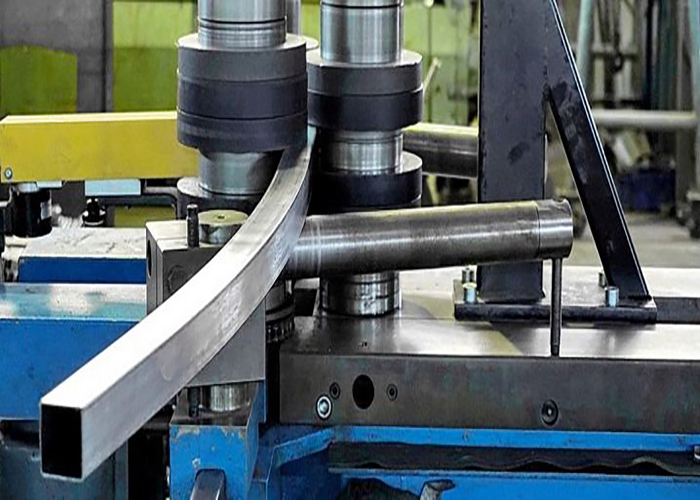
Stirrup Bender (Khamout-Zan) To use rebar longitudinally or transversely in construction, it must be shaped into specific forms for reinforcement in concrete structures. A stirrup is a type of transverse reinforcement designed to increase a building’s resistance to shear and torsion forces. Stirrup benders can automatically or semi-automatically cut and shape rebar into square or circular forms.
Threading/Cutting Machine (Hadideh) This machine can cut plain rebar up to size 50 and deformed (ribbed) rebar up to size 45 while maintaining strict cutting and component standards.
F-Wrench One of the simplest tools for bending thin rebar. Made of hardened steel to withstand high pressure, the wrench’s opening must match the product’s diameter to ensure a secure fit and a high-quality bend.
Rebar Bending and Cutting Workbench Used primarily for manual operations, this workbench reduces physical strain on the operator and increases safety. Standard dimensions are typically 80 cm by 100 cm, though some versions extend to 2 or 4 meters. These tables are mostly used for cutting wire, tied reinforcements, and mesh grids.
Portable Electric Cutter This device is utilized for rebar products ranging from size 18 to 25.